So, I wrote a book
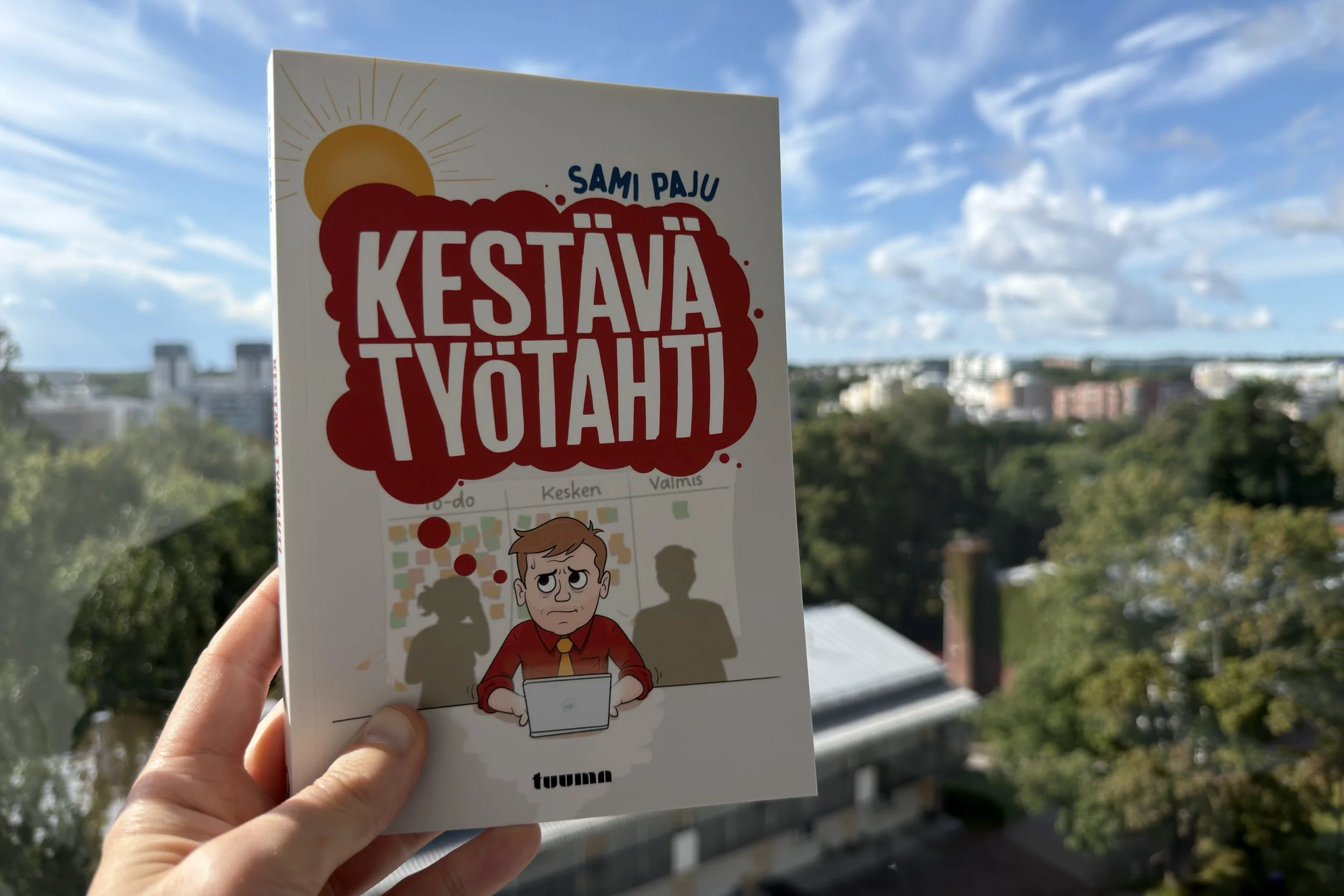
The feeling is strange. I started gathering my thoughts and background material for a book about sustainable pace about four years ago. The active writing and research period, when I worked on the book almost on a daily basis, lasted for close to two years. A few months ago the book was finally done and went to the printers, and I had nothing to do but wait.
The work was done, but what comes out of it remained a mystery. Still does. The book is not the point. Its having a positive impact is.
The book was officially published yesterday in Finland. It's aptly called Kestävä työtahti, which means sustainable working pace in Finnish. You can get a special offer for it here.
I was also on TV for the first time, talking about my work and what sustainable pace is about. The interview was short and it's in Finnish, but if you're interested, you can watch it here.
The term sustainable pace was inspired by the Agile Manifesto ("Agile processes promote sustainable development. The sponsors, developers, and users should be able to maintain a constant pace indefinitely."), but as I started to research and write about it, it developed into a practical theory of effectiveness for modern knowledge work, not just software development.
The starting premise is that the way knowledge work is organised and performed is misaligned with how the human brain processes information, and that this misalignment is a root cause of both poor organisational productivity and unnecessary strain, exhaustion and burnout for individuals. Addressing it improves outcomes for organisations and people at the same time, rather than trading one against the other.
The sustainable pace framework covers cognitive load, attention, task management, planning under uncertainty and energy management across individual, team and organisational levels. It rests on six principles:
Focus on impact and value. Prioritise work that creates value. Optimise work that is necessary. Avoid work that is useless or wasteful.
Embrace uncertainty. Surprises are the only thing that can be expected. The less slack in a schedule, the more time is wasted when they happen.
Limit work-in-progress. Overhead increases exponentially with the number of things in progress at the same time.
Make work visible. The more fragmented the visibility into tasks, projects and commitments, the harder it is to plan and prioritise.
Reduce context-switching. Shifting attention between tasks or contexts slows delivery and drains energy.
Manage your energy. The impact of work does not correlate directly with time spent on it, especially in creative work and problem-solving.
In addition to working on the book, I spent the last five and a half years at VTT, a Finnish state-owned deep-tech research institute, where I trained and coached hundreds of professionals and built the organisation's agile approach from scratch. Then a couple of months ago our entire team was let go as part of a broader restructuring to fit the new organisational strategy.
So now I am fully invested in making knowledge work more impactful, effective and sustainable. I have done corporate training and speaking engagements professionally for more than a decade, but never before this without also working for a larger organisation at the same time. With the book out now, and my having the opportunity to dedicate more of my time to its core message, I am hopeful about the future. If we want to improve well-being and life satisfaction, as well as organisational effectiveness, we need to find better ways to lead, manage, organise and do knowledge work.
When 53% of leaders say that productivity must increase but 80% of the workforce, leaders included, feel that there's not enough time or energy to do their work, something fundamental has to change. When 48% of people quit because of issues related to mental health or work-life balance, it's clear that the way the work works is not working.
Like I said, the book itself doesn't matter. How well its being out there will help change these outcomes is its true measure of success. And I aim to do my darnedest to make sure this topic will not fade away. My weekly newsletter is one part of it.
If you think your organisation would benefit from a talk, training or workshop on sustainable pace, you can find out more information on my website. Looking at the data, it's not just us Finns who're struggling with workloads, but the problems related to knowledge work are truly global.
So let's get to work and do something about it.